
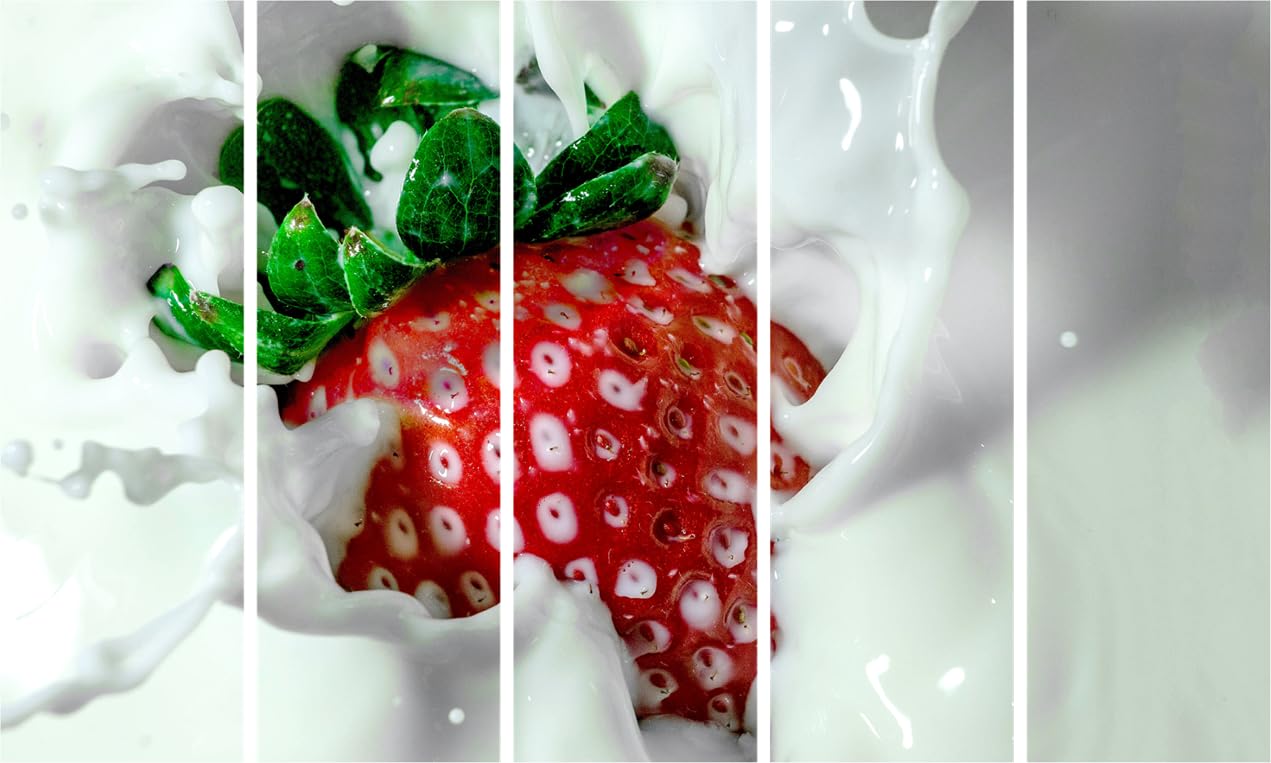
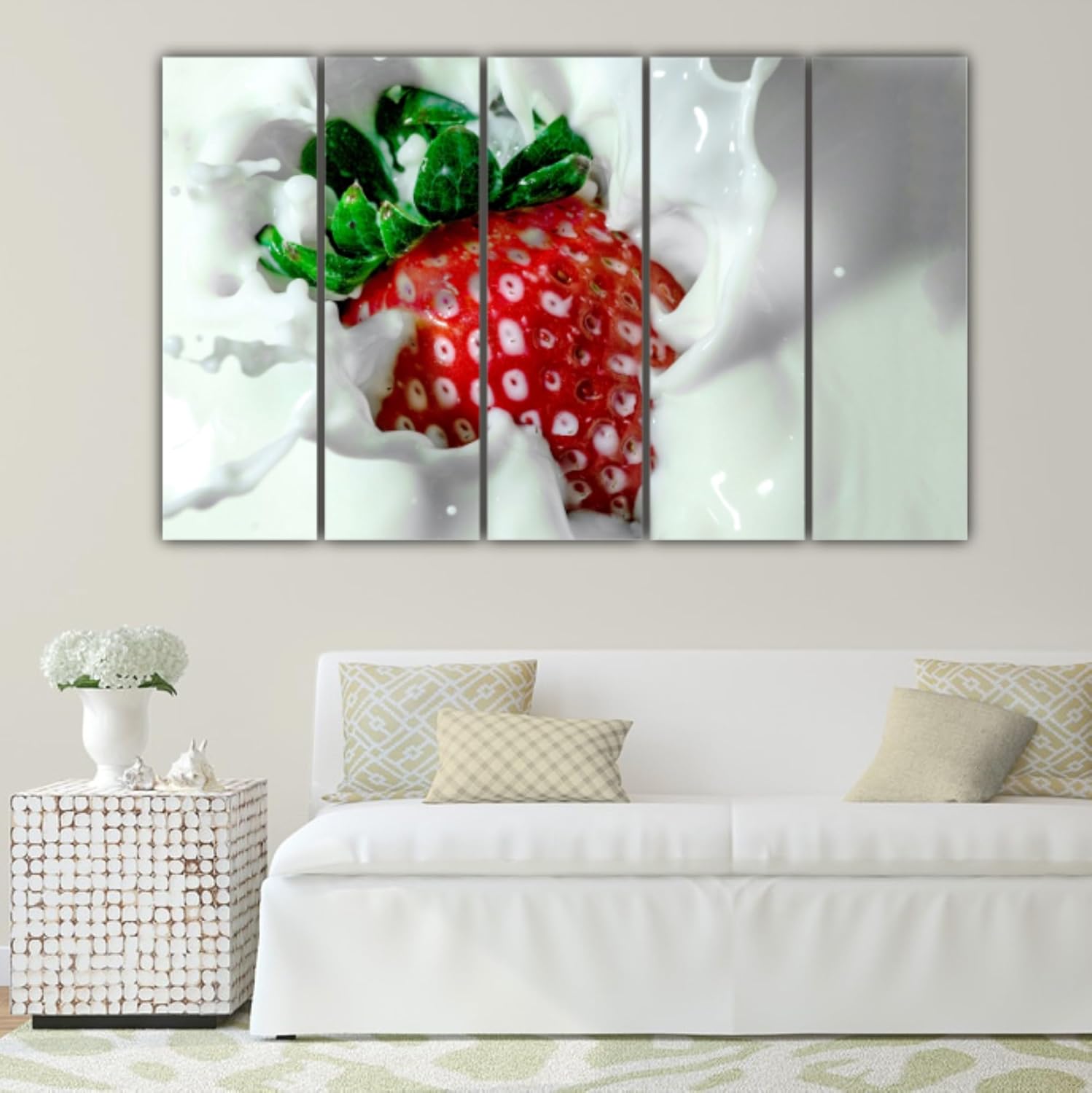
Berry Bliss Photography Framed Wall Art Strawberry Multi-Frame Delight (150x76cm)
You may also like

Moolwan 5-Panel Strawberry Splash Canvas Wall Art Painting (127x76cm) - Multi-Frame Kitchen & Living Room Art
You might have browsed dozens of kitchen wall art by now. Some were too muted—those pale watercolors that disappear into cream walls. Some were too loud—oversaturated prints that clash with everything. You probably kept coming back to something around 127cm—because intuitively, it fills a 10-12 foot wall without overwhelming it. But you want to be sure.
This strawberry splash canvas gives you what those other options couldn't: controlled vibrancy. The deep red strawberry and crisp white milk splash create visual energy without the aggressive brightness of typical fruit art. On your 12-foot wall, 127cm spans roughly 35% of the width—enough to anchor the space, leaving about 116cm breathing room on each side. It's sized for impact, not decoration.
The Visual Math: How 127cm Fits 10-12ft Walls in Indian Homes
Your wall is probably around 10-12 feet wide (300-360cm). At 127cm, this canvas covers approximately 35-42% of that width—the range interior designers consider "statement without domination." Here's what that means practically:
On a 12-foot (360cm) wall: 116cm empty space on each side. The canvas becomes a clear focal point while your wall retains its proportions.
On a 10-foot (300cm) wall: 86cm empty space on each side. Fuller coverage, more dramatic presence, still balanced.
Compare this to the 90cm options you might have considered—those leave 135cm of emptiness on each side of a 12-foot wall, making the art look like an afterthought rather than a design choice.
Why Red and White Work in Indian Living Rooms (Not Just Online Photos)
The strawberry's red sits in a specific range—not the orange-red of cheap prints, not the purple-red that fights with warm lighting. This is a true, clean red that holds its tone under both natural daylight and warm LED bulbs (2700-3000K) that most Indian homes use in the evening.
The white milk splash is actually working harder than you think. Against your cream or off-white walls (the standard in Indian apartments), pure white creates definition. The splash draws the eye across all five panels, making the 127cm span feel intentional rather than just "wide."
If your sofa is brown or beige (most are), the red provides contrast without clashing. If you have wooden furniture—which you probably do—the warm undertones in this red complement rather than compete.
Rental-Friendly Mounting: How to Hang Without Losing Your Deposit
Five panels. Five hooks. Each panel weighs approximately 600 grams—light enough for standard picture hooks, no wall anchors needed. The total 3kg distributed across five points means minimal wall stress.
You'll need five small nails or adhesive hooks rated for 1kg each. The gaps between panels? About 2-3cm works visually. Mount the center panel first at eye level (roughly 145-150cm from floor to center), then work outward.
If you're in a rental and worried about your ₹50,000 deposit, here's the reality: small nail holes in Indian plaster are trivial fixes. But if you want zero damage, heavy-duty adhesive strips (Command or local equivalents) handle 600g per panel easily. Remove cleanly when you move.
How This Compares to Smaller Sizes You've Been Considering
At 90cm width, you'd get the same image at 70% of this visual impact. The math changes everything: 90cm on a 12-foot wall is 25% coverage. That's accent-piece territory—nice, but not the statement you're probably looking for if you've browsed this far.
At 150cm width, you'd push to 42% coverage on a 12-foot wall. Bigger, yes, but the strawberry starts to dominate rather than anchor. And on a 10-foot wall, 50% coverage begins to feel cramped.
127cm hits the middle ground where you're making a deliberate design choice without gambling on whether bigger is better.
What This Will Look Like in Your Living Room (Morning vs. Evening)
Morning light (east-facing windows, which most Indian living rooms have): The white splash will appear brightest, the red will look slightly lighter. Fresh, energetic.
Evening LED light (warm white): The red deepens, the white takes on a cream tint. More dramatic, slightly warmer overall.
Both work. The photographic quality means color shifts don't introduce muddy tones—you'll just see the same image with different emotional temperatures.
From 8-10 feet away (typical sofa-to-wall distance in Indian living rooms), the five panels merge into a continuous image. The seams disappear perceptually. Up close, you see the individual frames—deliberate, gallery-style.
Quick Specifications
- Product: Moolwan 5-Panel Strawberry Splash Canvas Wall Art Painting
- Overall Dimensions: 127cm (W) × 76cm (H) × 0.6cm (D)
- Individual Panels: 5 framed sections with 2-3cm gap spacing
- Total Weight: 3000 grams (approximately 600g per panel)
- Canvas: 340 GSM cotton with moisture-resistant coating
- Frame: 1.5" kiln-dried pinewood (12% moisture content)
- Inks: Eco-solvent UV-resistant for fade protection
- Mounting: Standard picture hooks; rental-friendly options available
- Price: ₹2,796
- Delivery: 5-6 days metro cities, 6-8 days tier-2/3